PEGAFFI · Education Guides · Design Your Ring
Lab Grown vs. Natural Diamonds: What's the Real Difference?
2026-09-01 · 6 min read
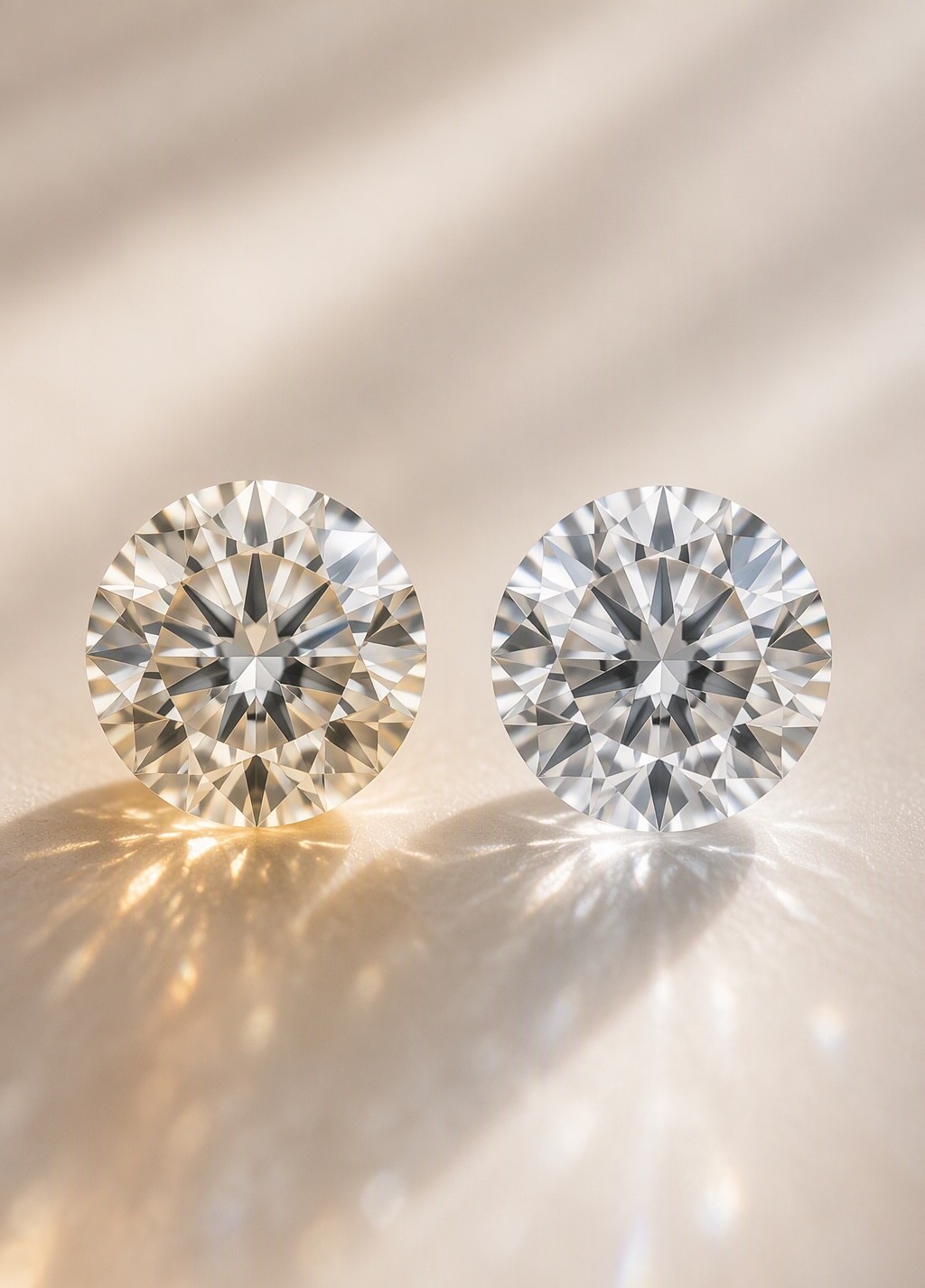
If you take one fact away from this guide, take this: a lab grown diamond is not a simulant, an imitation or a "fake". It is a real diamond — the same carbon crystal, the same hardness of 10 on the Mohs scale, the same refractive fire. Even a trained gemologist cannot tell a lab grown diamond from a mined one with the naked eye; identification requires specialized laboratory equipment that detects trace growth patterns.
How lab grown diamonds are made
Natural diamonds formed 1–3 billion years ago under extreme heat and pressure deep in the Earth's mantle. Lab grown diamonds recreate those conditions in weeks, using one of two methods:
- HPHT (High Pressure High Temperature) — a diamond seed is placed in carbon and subjected to roughly 1,500°C and 1.5 million pounds of pressure per square inch, mimicking the Earth's mantle.
- CVD (Chemical Vapor Deposition) — a thin diamond seed is placed in a chamber filled with carbon-rich gas; the gas is ionized and carbon atoms rain down onto the seed, growing the crystal layer by layer.
Both methods produce genuine diamond crystals that are then cut, polished and graded exactly like mined stones. At PEGAFFI we grow and cut our own rough in our Guangzhou factory, which is why we can stand behind every stone from its first day as a seed.
The honest comparison
| Lab Grown | Natural / Mined | |
|---|---|---|
| Chemical composition | Pure carbon crystal | Pure carbon crystal |
| Hardness (Mohs) | 10 | 10 |
| Brilliance & fire | Identical optics | Identical optics |
| Grading | IGI / GIA certified | GIA / IGI certified |
| Typical price (1ct, fine quality) | $400 – $900 | $4,000 – $7,000 |
| Origin | Grown in weeks, zero mining | Formed over billions of years, mined |
| Resale market | Young, still forming | Established but depreciates at retail |
Certification and disclosure
Reputable lab grown diamonds are graded by the same independent laboratories — IGI and GIA — using the same 4Cs standards. Every report clearly states the stone is laboratory-grown, and the girdle is laser-inscribed accordingly. In line with the U.S. FTC Jewelry Guides, we disclose laboratory-grown origin everywhere: on the product page, on the certificate and on your invoice. You should expect nothing less from any seller.
Let's be honest about resale value
No diamond — mined or lab grown — should be bought as a financial investment. Retail prices of both categories include craftsmanship and retail margin that you do not recover on resale. Lab grown prices have fallen as production scaled, which is wonderful for buyers today and means you should buy the stone you love at a price that makes sense now, not speculate on future value.
So which should you choose?
Choose natural if geological rarity and tradition carry deep personal meaning for you and the premium fits your budget comfortably. Choose lab grown if you want a larger or higher-quality stone for the same budget, prefer to avoid mining, or simply believe the symbol matters more than the origin story. Roughly 70% of the budget saved can go toward the setting, the proposal, or the honeymoon — the stone on the hand will sparkle exactly the same.
Every PEGAFFI center stone is an IGI-certified lab grown diamond with laser inscription, always disclosed as laboratory-grown. That is a promise in writing, not a marketing line.